The Frontier Collapse
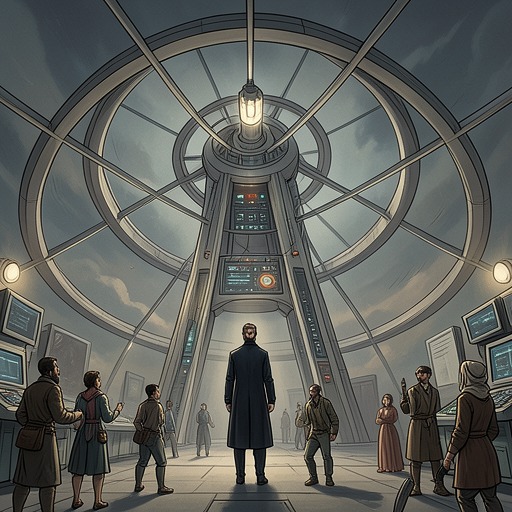
Systema Delenda EstThe Frontier Collapse is the moment when the System’s frontier ceases to be a functioning extension of the Core and becomes the principal theater of Cato’s war for liberation. It begins with the sudden withdrawal of deities and the closure of the portals, but it does not end in passive collapse: Cato converts the emergency into a coordinated seizure of hundreds of thousands of worlds, using The Phage, Chill Out, micro-warframes, digitization pods, and FungusNet to rescue as many inhabitants as possible while dismantling the infrastructure that kept the System in place. The event therefore carries a double movement: the frontier is abandoned by its rulers and simultaneously claimed by an insurgent civilization whose own expansion has become the only available evacuation system.
Causes and Strategic Background
The collapse follows years of exponential industrial growth. Cato began as an ordinary postbiological citizen disgusted by the System’s devastation of Earth, where technological failure, monsters, and game-like physics had killed billions. He entered the System through a portal after Earth was freed, bringing neither magic nor a permitted System solution, but the technology and knowledge of a civilization approaching the second rank of the Kardashev scale. His method was to operate inside the System while refusing to accept its rules as the limits of possibility.
That strategy initially advanced slowly. On the moon, Cato kept watch over a small number of drones while they excavated silicates, carbides, volatiles, and metals; a rudimentary solar array and a hacked-together manufactory represented the first fragile steps of an industrial base. The narrative repeatedly stresses that exponential growth can be deceptively slow at the beginning. Over time, however, Lineages spread Cato’s presence to hundreds of worlds, and each world developed factories, mines, refineries, atmospheric extraction, frozen-volatile processing, and immense solar-panel fields. Even when only a small proportion of production was devoted to weapons and warframes, the absolute scale became staggering. The frontier collapse is the delayed consequence of that accumulation: a network that once made Cato appear dispersed and locally constrained suddenly gives him a manufacturing and response capacity on a System-wide scale.
The System’s authorities had already shown that they could destroy worlds as a means of control. When an exterminatus condemned more than twelve million Copper- and Silver-rank inhabitants of a Gaekos homeworld, the act threatened not merely political defeat but genocide. Cato answered with millions of one-ton cannisters, half intended to blanket the planet in System-jamming biology and half reserved for the larger technological purpose of producing biological agents on demand. Earlier confrontations had also demonstrated that Cato’s infrastructure was incompatible with the System: when Initik seized Cato’s bases on Uriva’s moons, arcane machinery stopped, domed habitats failed, biological production halted, and mechanisms melted, burned, or exploded. The conflict was thus not a conventional rebellion over administration. It was a struggle between incompatible realities, each trying to determine whether the other could continue to exist.
Portal Closure and the Frontier Emergency
The immediate trigger is the closure of the portals. Cato-Heimdall is already in framejack when the reports arrive, and the new Alums brought in through Project Exodus have placed him and Raine, Leese, Meshka Uriv, and Temek Uriv in a simulated war room. Feeds cover every wall with surveillance and reports from other worlds. The portals have not vanished; they merely prevent people from passing through them, which leaves open a narrow but crucial possibility: those fleeing the Inner Worlds can still be digitized and transmitted across the portal boundaries.
The scale of the announcement turns strategic danger into catastrophe. Cato reports that every world is affected and that the entire frontier is being shut down. Hundreds of thousands of Cato or Lineage instances report that a deity has left each world and that a quest has appeared for its inhabitants. The movement is not simply an evacuation order associated with a single world purge. Billions of people spread across hundreds of thousands of worlds are being pushed beyond Cato’s reach, toward worlds that are already doomed or that will soon become inaccessible. Temek Uriv observes that the confrontation had always been a contest over who would move first; Cato admits that he had delayed until his anti-Core weapon was more advanced, but the closure removes that choice.
Cato’s decision is also informed by earlier evidence from severed worlds. Transmissions from the first annexation showed that a world’s System fails on its own when the world is cut off from the network and the Core. That discovery removes one of his greatest fears: a missed world will not necessarily become a second expansionistic System after the severance. The danger remains that the Core may open portals to destinations Cato cannot reach, but the frontier’s isolation is no longer only a loss. It is an opportunity to attack before the remaining System structure can consolidate its escape routes.
The Offensive Across the Worlds
Cato orders the frontier taken. Across its full extent, versions of Cato and Lineages activate The Phage, while Chill Out saturates the atmosphere and places most inhabitants into forced lassitude. Micro-warframes assemble directly from the ground, and additional units descend from the sky as the intervention forces move in. The operation is therefore both military assault and emergency containment: the weapons suppress resistance, while the rapid deployment prevents the System from removing more people before Cato can reach them.
Exterminatus timers begin appearing as worlds register Cato’s presence. Digital citizens face a sudden deadline and respond in several distinct ways: some relocate, some duplicate themselves across worlds, and others reconcile their divergent copies back into a single individual. FungusNet reaches peak capacity as activity erupts across more than half a million worlds. The technology that had served as Cato’s distributed nervous system becomes an evacuation artery, carrying identities and information across distances that physical matter can no longer cross.
Most frontier worlds do not require total mass digitization. Without deity oversight or high-rank elites to obstruct the offensive, Cato’s forces quickly destroy the dungeons and Nexus buildings on world after world. The populations send final signoffs, the portals close, and the planets return to lightspeed communications. This outcome is a qualified liberation rather than an uncomplicated rescue. Some worlds lie only dozens of light-years apart, while others are hundreds or thousands of light-years from their nearest neighbors. Their future depends on slower-than-light manufacturing probes and centuries of infrastructure building, even though every Cato possesses the copied database containing the accumulated knowledge of humanity’s civilization.
The resulting frontier is paradoxical. It is technologically connected by shared knowledge but physically fragmented by the loss of the portal network. Because many worlds had possessed little culture beyond the endless struggle imposed by the System, the isolated planets may ultimately become more recognizably human than the worlds that remain inside the old order. The System had offered instantaneous access at the cost of coercive sameness; the collapse offers autonomy at the price of distance, delay, and reconstruction.
Evacuation, Digitization, and Unequal Survival
The rescue operation continues beyond the initial assault. Alums escaping the Inner Worlds filter out toward Hunting Worlds, where prepared digitization pods wait in orbit. Their digital selves are transmitted to Heimdall through FungusNet. Electromagnetic radiation still crosses the former portal boundaries even though physical matter cannot, creating a narrow communications and transfer channel that Cato exploits. The survival route is technologically sophisticated but numerically inadequate: of roughly twenty thousand Alums, only eight hundred have been contacted and persuaded to leave.
Shiel-Ruyu performs most of the recruiting and may have killed several Alums during the process. Cato does not condemn that violence, recognizing that the rescue itself is taking place under exterminatus conditions. Shiel-Ruyu’s unusual identity further complicates the boundary between individual and collective survival: two intelligences inhabit one body, naturally rather than through the engineered arrangement of a Jager Frame. A few humans are among the rescued Alums, but most humans appear to prefer the System to the civilization from which Cato came, even though an equivalent System could be recreated in virtual reality or through an Angelnet. Lorraine is identified as an exception to that preference.
The frontier collapse consequently does not produce universal liberation at once. It sorts inhabitants according to rank, access, willingness to leave, technical compatibility, and proximity to Cato’s preparations. Some people are digitized, some flee, some duplicate themselves, and some remain behind. The event preserves the possibility of a future outside the System, but it also makes survival dependent on the very infrastructures Cato has spent years constructing.
Consequences and Narrative Significance
The collapse changes the conflict from a campaign of infiltration and gradual annexation into an open contest over the fate of the System’s remaining architecture. Cato’s forces dismantle the mechanisms of System control while the frontier worlds lose their instantaneous political and economic unity. The result is a cascade: divine withdrawal exposes local populations, portal closure isolates them, Cato’s distributed industry makes intervention possible, and the destruction of dungeons and Nexus buildings prevents the System from reconstituting its authority.
The event also anticipates the later confrontation between Cato and Misse Eln. When Misse appears as the power behind the sudden absorption of Mishkell and the collapse of the frontier, she treats Cato as the cause of the crisis, while Cato rejects the accusation and distinguishes his quarrel with the System from a quarrel with her personally. Their exchange makes the frontier’s political meaning explicit: the collapse is not an accidental infrastructure failure but the visible consequence of competing claims over who may govern worlds and define liberation.
At the largest scale, the event mirrors the System’s arrival on Earth. The System once imposed new physics, monsters, and mass death upon a population that had not chosen the game. During the frontier collapse, Cato imposes an equally radical transition away from that order, using forced lassitude, biological weapons, warframes, digitization, and destruction of System facilities to prevent the old structure from surviving. The moral contrast is therefore deliberately unstable. Cato seeks to remove the System and preserve its people, but the operation still resembles a controlled planetary emergency in which populations are acted upon before they can consent.
The decisive value shift is from System access to systemless survival. At first, portal closure appears to mean that billions have been lost beyond Cato’s reach. Once Cato commits to taking the frontier, the same closure becomes the condition under which the worlds can be severed from the Core and their local Systems allowed to fail. The victory is neither a return to the old world nor a clean restoration of freedom. It is a forced passage into a dispersed future in which the surviving worlds possess the means to rebuild, but must do so across distances measured in centuries.